
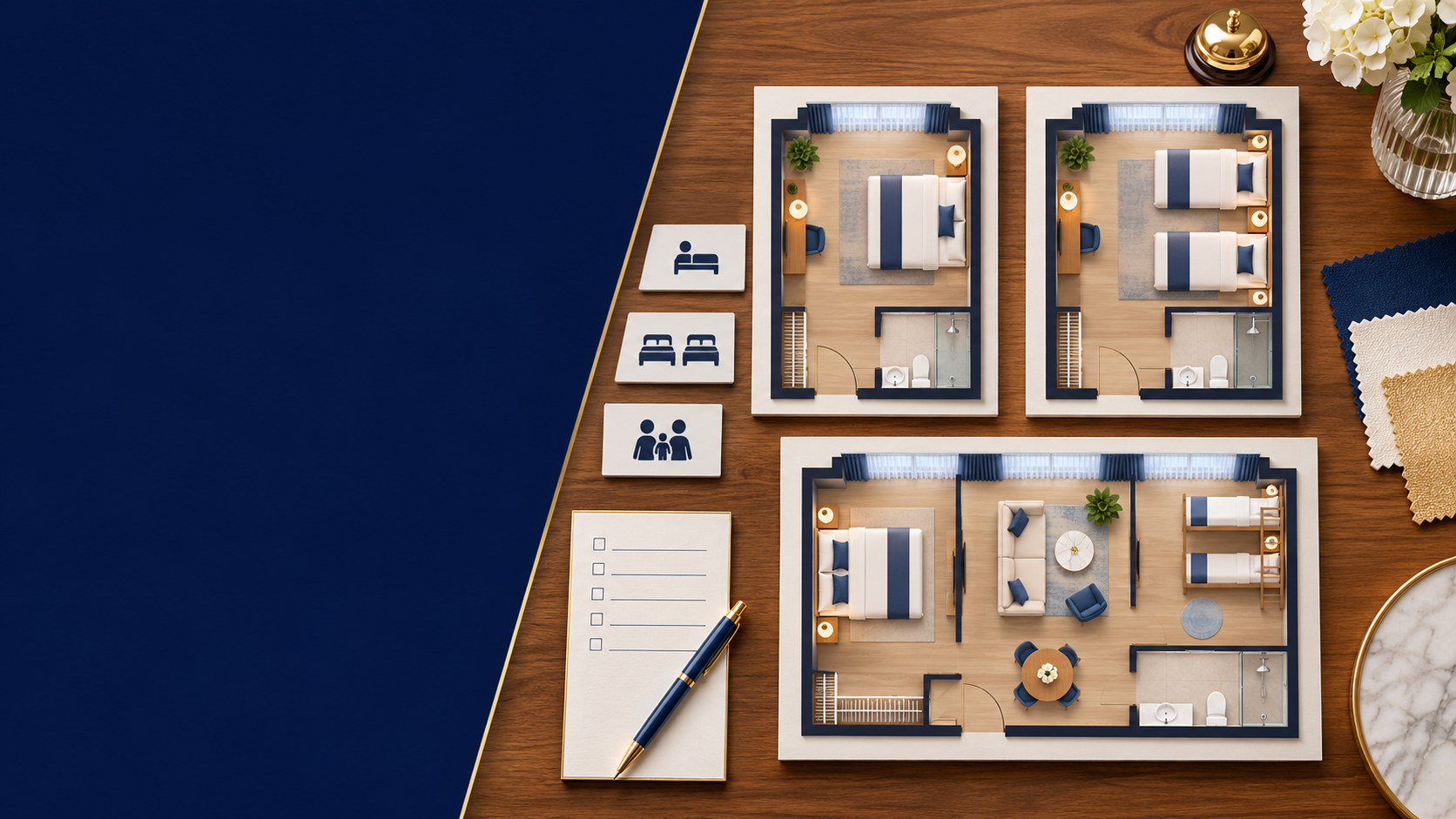
Build a room mix around guest needs, space constraints and services the team can deliver. Compare scenarios with explicit assumptions instead of starting from a standard ratio or the maximum beds that fit a drawing.
Before naming room categories, decide what configurations the property should offer and how they affect operations. This guide structures a conversation with designers and feasibility specialists. It is not a building plan or a universal room-mix formula.
Match proposed use with the room
Start with supported needs, such as solo stays, travelling together or longer visits. Separate essentials from assumptions. Explain how each proposed room helps and where it is limited; a competitor's category name is not sufficient justification.
Discuss beds, bathroom privacy, luggage space and shared facilities as facts before using labels such as Family or Superior. Sales naming follows a clear deliverable.
Compare scenarios on the same basis
| Question | Scenario one | Scenario two | Missing evidence |
|---|---|---|---|
| Intended guest use | Reason for stay | Reason for stay | Enquiries or demand information |
| Configuration | Beds, bathroom and space | Beds, bathroom and space | Appropriately reviewed layout |
| Service work | Cleaning, linen and supplies | Cleaning, linen and supplies | Relevant operating trial |
| Storage and common areas | Supporting needs | Supporting needs | Space limitations |
| Flexibility | Possible changes in use | Possible changes in use | Sales-system and investment effects |
Percentages need not precede evidence. First identify what each scenario requires you to prove, then develop quantities with the relevant people.
Consider work after the room sells
Different configurations may require different linen, replenishment and preparation. Have actual operators check storage and work routes. Do not infer a universal cleaning time from bed count; collect relevant trial observations.
If the model switches selling arrangements, check reservation relationships and what staff must reset. Moving a bed in a drawing does not establish that the inventory can safely switch every day.
A fictional flexible-room example
A proposal allows the bed arrangement to change for two guest needs. Check equipment storage, how the chosen arrangement is confirmed before arrival and who verifies the setup. Without space or an owner, flexibility may become a source of mistakes.
A fixed configuration may be simpler to deliver but serve different needs. Examine demand evidence and costs for both rather than declaring flexibility always better. This example supplies no revenue projection or recommended ratio.
Preserve decision-changing assumptions
Write why a scenario is preferred and what contrary evidence would change the decision. Guest enquiries may not support the assumed configuration, or service space may be insufficient. Assign evidence collection before committing to difficult-to-reverse work.
Building design, safety and permitted use require appropriate specialist assessment. Feasibility needs its own explicit assumptions. A room-mix table does not approve a project.
Before committing to the mix
- Connect every configuration to an intended need.
- Separate facts from untested demand.
- Consider service space and storage.
- Have operating staff review linen, cleaning and supplies.
- Check selling relationships against double sale.
- Refer specialist questions appropriately.
- Preserve assumptions that could change the plan.
Frequently asked questions
Is there a standard ratio I can copy?
This guide offers none. Guest evidence, space and operating conditions vary; the selected mix needs a property-specific rationale.
Can I copy a competitor's mix?
Use it to generate questions. A public room list does not reveal their sales or operating problems, and does not establish fit for your property.
Connect design choices with operations
Ask LINE OA @kines about current Hotelpreneur details, course format and available dates.
Use the small-hotel feasibility guide to develop each scenario's assumptions further.
Tool provenance
This Kines editorial comparison draws on guest, room-size and service-preparation concepts. It is not an architectural plan or evidence that one mix maximises returns.